
Intelligent call analysis system for the 109 service
From residents’ voice calls to early detection of widespread problems and management decisions. A phased implementation concept: the first stage runs until the end of 2026.
- speech analytics
- structured data
- early problem detection
- decision support
- Department of Digitalisation and Archives
- Department
- Phased implementation concept
- Status
- Until the end of 2026
- First stage
- August 2026
- Date
Today, valuable signals about residents’ problems stay locked inside audio recordings
- calls to the 109 service every day
- 50–200
- calls per month across the 109 and 112 lines
- 20–30k
- 01
Analysis relies mostly on call cards and manual work
- 02
A rise in similar calls is hard to spot in time
- 03
Voice data is not used as a source of analytics
We see calls one by one, but we do not always see the problem in detail at scale.
From handling individual calls to a single picture of the situation
109 calls
Structured data on residents’ problems
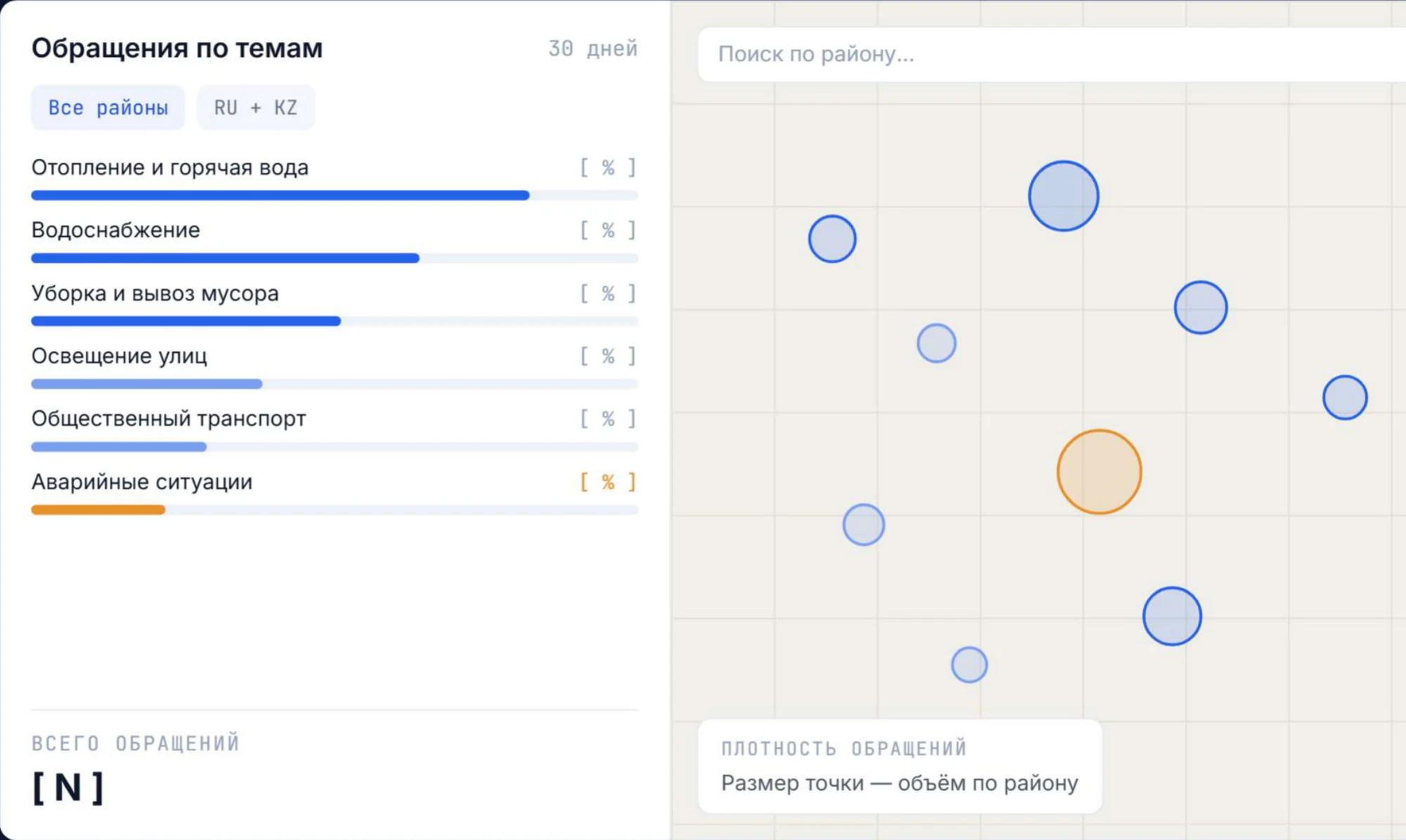
Analysis of topics, areas, trends and emotional tone
Early detection of widespread problems and decision support
- 109
- RAC
- floods ↗
- media scanner ↗
- other relevant sources
The system does not replace staff or make decisions automatically — it helps notice important signals sooner.
The project grows in stages, with a practical result every year
- 2026
Speech analytics and structuring of 109 calls
- Next stage
Matching with RAC, flood data and the media scanner
- Then
Analysis of relationships and early risk detection
- Later
Intelligent services for management and residents
Each stage creates data and practical value for the next one.
In 2026 we create a new source of management data based on 109 calls
- 01
Coverage
All incoming 109 calls, in Russian and Kazakh.
- 02
Understanding content
Topic, problem, area, object, urgency, emotional tone.
- 03
Regular analytics
Daily and weekly reports, trends, new and growing topics.
- 04
Foundation for growth
Labelled data, a catalogue of topics and tags, a basis for cross-system analysis.
- topic
- problem
- area
- object
- urgency
- emotional tone
- recurrence
The list of topics is not fixed in advance: the system surfaces new and growing call topics.
Additional result: 100 hours of transcribed and labelled recordings prepared on a current request.
The first stage delivers a practical effect as early as 2026
Practical effect
- Voice calls become structured data
- A daily and weekly picture of problems emerges
- A rise in similar calls is detected faster
- Statistics on repeat calls and mass incidents take shape
- A foundation is laid for integration with RAC, flood data and the media scanner
- Dependence on manual analysis of recordings decreases
Support needed
- Assign staff to label and verify data
- Agree on priority management topics
- Approve the procedure for responding to detected signals
- Ensure cooperation with the relevant departments
Data is processed and stored within the local secure environment of the Department of Digitalisation and Archives.
Need a similar system?
Tell us about the task — we will propose a solution architecture, estimate the timeline and assess a pilot.